Showing posts with label australia. Show all posts

Monday, 1 April 2013

Fear-mongering stops Aussie Islamic School

Plans to establish a new Islamic school in Mernda, a suburb in Australia’s south-eastern state of Victoria, have received a knockout for reasons seen as resulting from the growing anti-Islam sentiments in the society.
“They were afraid there was going to be a mosque there or noise from call to prayers or whatever,” Councilor John Fry, who supported the plan, told the Herald Sun newspaper on Tuesday, March 27.
“There didn’t seem to be an understanding of what the actual proposal was.”
An Islamic school was proposed to be built on a heritage site in Mernda by the Great Prophet Center, an Iraqi community group.
But residents objected the Islamic school plans, correcting 2,000 signatures to veto down the proposal.
Only 75 objections came from Mernda area, while more than 90 percent of the total objections were coordinated through a group called Friends of Mernda Heritage Site, according to a report by the council planning officers.
“The Friends group has advised planning officers that many of the objections from those not residing in the area have typically been signed by friends and family of those living in proximity to the (heritage) area … and individuals having an interest in the heritage precinct or heritage issues more generally,” it said.
Though the council’s planning officials recommended building the school, the council rejected the proposal.
Councilor Fry confirmed that the 125-student school was barred due to anti-Muslim sentiments stirred by ignorance.
“There is an unfortunate thing that people who don’t understand different cultures can react negatively,” he said.
However, councilor Pam McLeod, who voted against the Muslim school proposal, said it was all about traffic and heritage matters.
“Nothing that was put in front of me had any element of racism that I could see,” she said.
“We are one of the most multicultural communities in terms of a municipality in Victoria so how could you possibly be racist or favoring one group over another. It’s just not on.”
Scaremongering
But Victoria Muslims accused opponents and council officials of discrimination.
“We believe that strong objections against the school were because of our background,” Great Prophet Center spokesman Hassan Al Khirsany told The Herald Sun.
Al Khirsany portrayed the issue as “fear mongering” by anti-Muslim groups, arguing that if this plan were for a catholic school, it would not have met any objections.
“Signatures were collected by old generation people who were telling others that this school might turn into a mosque and the call for morning prayer will cause lots of noise,” he said.
Islamic Council of Victoria spokesman Nazeem Hussain said it was puzzling that the council had rejected the advice of its own staff on the feasibility of the project.
“It would be upsetting and unfortunate if the basis for these objections was due to anti-Muslim undercurrents,” he said.
“Given that many of these objections came from outside of the Mernda area, it would suggest that there has been a concerted effort to not see this project come to fruition, as opposed to there being bona fide traffic or planning concerns.”
He added that Victoria was a vibrant multicultural society that shouldn’t “succumb to ideas that divide us”.
Muslims, who have been in Australia for more than 200 years, make up 1.7 percent of its 20-million population. Islam is the country’s second largest religion after Christianity.
In post 9/11 Australia, Muslims have been haunted with suspicion and have had their patriotism questioned.
A 2007 poll taken by the Issues Deliberation Australia (IDA) think-tank found that Australians basically see Islam as a threat to the Australian way of life.
A recent governmental report revealed that Muslims are facing deep-seated Islamophobia and race-based treatment like never before.

Tuesday, 26 March 2013

Mufti of Australia to follow local moon-sighting… except for Eid Al-Adha

The office of the Mufti of Australia Professor Dr Ibrahim Abu Mohammed, issued a statement that the official date for the Eid Al-Adha will be Sunday 6th of November 2011.
The statement which was released 4 days after the beginning of Dhul Hijjah explained that the policy of the Mufti’s office will be to follow moon-sighting for every lunar month.
The Federal Council of Imams, including the Council of Ifta (Islamic ruling) have been lately keen to verify the sighting of the crescent with the beginning of every Arabic (Lunar) month
This is with the exception of this month, the month of Dhul Hijjah
This process will, God willing, continue with the beginning of every Arabic month throughout the year… with the exemption of the month of Dhul Hijjah.
This is to follow Saudi which administers the affairs of Hajj
This exemption is because running the affairs in this respect is for the country where the rituals of Hajj… The Kingdom of Saudi Arabia

It remain to be seen whether Islamic organisations that adhere to the  local moon-sighting methodology will follow the Mufti in taking the exemption for Eid- Al-Adha
To download the full statement Click Here

Australia’s Mufti on identity, unity & radicals


Egyptian-born Ibrahim Abu Mohamed is the new Mufti of Australia. A political moderate, though religiously orthodox, he faces formidable challenges within and outside of the Islamic community, writes Barney Zwartz.
IT IS the oddest question I have been advised to ask the new Mufti of Australia, the figurehead of Australian Islam: why don’t you wear the clothes of a man of God? Dr Ibrahim Abu Mohamed, immaculate in a beautifully cut navy suit with a lemon shirt and lemon and navy tie, is obviously taken aback, but he laughs and answers with aplomb. ”There is no specific Islamic clothing for the Muslim male. So whatever culture he’s living in, that’s how he dresses. But the one that gives the fatwa [religious ruling] is not the clothing, it’s the one inside the clothing.
”If I wear Islamic clothing then give it to someone else, would that person be able to give fatwas? Small minds debate men, larger minds debate things, great minds debate issues and ideologies.”
A much more important question, one everyone I speak to in preparing for this interview advises me to ask, concerns his poor command of English. How can he cope with the media, mainstream Australia and the diverse Muslim communities here if he has to do it through an interpreter?
This is something he has been asked a lot, he replies through his interpreter, Nasser Kat, saying he understands the importance of good English. ”I promise that, given time, I will solve this problem. I can understand 80 per cent of what is said and can reply, but I don’t feel that if I speak in English I will have the same speed, depth and richness that I speak in Arabic.”
But, he continues, more important than using English words is conveying the right meaning and ideas – language is not just words but culture, history, identity.
His diplomacy and tact should give Australia’s Muslims hope that his unanimous appointment as Mufti last month by the Australian National Imams Council may be third time lucky for the Muslim community. The first Mufti, Sheikh Taj al-din al-Hilali, from Lakemba Mosque – a few kilometres down the road from Dr Ibrahim’s radio station in the western Sydney suburb of Fairfield – was appointed to save him from deportation in 1988. His colourful language and claims made him a media sensation, but most Muslims outside Lakemba cringed at his antics.
Controversial remarks in 2006 comparing scantily clad women with ”uncovered meat” inviting rape were the last straw, and the imams replaced him with Sheikh Fehmi Naji el-Imam of Melbourne’s Preston Mosque, a gentle and popular leader. But Sheikh Fehmi, who was in his 80s and had suffered a serious stroke, was too ill to give the role any public traction.
With Egyptian-born Ibrahim Abu Mohamed, the imams have opted for a highly regarded scholar – he is the author of 26 books – but, it seems, a scholar with considerable political savvy. In his 60s, he is vigorous and confident, a political moderate though religiously orthodox. But, as he acknowledges, the challenges he faces are formidable, from unifying and integrating Muslims to clarifying misconceptions within and outside of the Islamic community.
I have flown to Sydney to meet the Mufti – the mountain, one might say (as I am a stout chap), has come to Mohamed. The taxi driver from the airport is a Lebanese Muslim who has heard of Dr Ibrahim but has no interest in what he says because Lebanon has its own mufti with a representative in Sydney. The Turks, one of the most numerous groups among Australian Muslims, have a natural rivalry with Arabs and are led by Turkish imams sent by the home government. Australia’s Muslim communities come from some 70 countries, and most have their own structures and leaders. How will the Mufti draw them together?
First comes the rhetoric. ”For Muslims there is a religious requirement that we establish good relations with 28 people: seven neighbours in front and behind and to each side,” he says. But because Australia has 20 million people, that means each of the nation’s 500,000 or so Muslims must befriend 40 people.
Then comes the diplomat and politician. ”It’s important to have lines of dialogue. My role as Mufti doesn’t invalidate the structures Muslims already have. My role is to complement what already exists, and those structures are a support to my role,” he says.
Rather than talking straight to the Turkish or Lebanese communities and risking being ignored, he will work with their leaders so that their credibility and his credibility reinforce each other.
”If I speak to the Turkish community they may not know or trust me, but if I speak through their own leaders they will understand me and may accept what I am saying.”
But Dr Ibrahim is still in honeymoon mode, because he has yet to begin his new role as Mufti. He plans to launch himself in about a month. Meanwhile, he goes to bed at 3am and rises at 6am so that he has time to plan what he wants to do in the job, how he will do it, and with whom. And when he does, it will be from a modest office, simply furnished, the walls decorated with quotes from the Koran and with a bumper sticker over the front door proclaiming ”We love Jesus too”.
Simplicity is nothing new to him. Ibrahim Abu Mohamed’s parents were small farmers who sent him to Islamic school almost as soon as he could speak. He could recite the whole Koran from memory by the time he was nine, a remarkable feat that marked him out.
”I was very devout,” he says. ”I had a very deep awareness of Allah from then until now. I’m still very struck by awareness of God.”
He was an avid reader, devouring everything his eyes fell on, but he did not plan to be a scholar. He wanted to be a pilot, and even began the preparation, but had to give up. ”My mother was worried, and cried, and was adamant that I not do it.”
He studied at Islam’s most famous university, Al-Azhar at Cairo, where he got his doctorate, then from 1988 to 1996 he taught Islamic studies in Abu Dhabi before moving to Sydney in 1997. He founded his radio station soon after arriving in Australia. Called Quran Kareem Radio, it broadcasts 24 hours a day, providing Koranic readings and other religious programs, mostly in Arabic, and relies on local donations and advertising. In 2005 he founded a respite centre for Muslims with special needs, which he still manages.
Does Dr Ibrahim see the role of Mufti as symbolic and ceremonial, as providing rulings on religious questions, or as providing social leadership in dealing with the media and politicians? All of those, he replies, but one of the most challenging missions is to merge the Muslims of Australia into the collective ”we”, part of the national identity of Australia, while still being Muslims.
”It’s very important that the Muslim community feels an integral part of Australia, not a ghetto or an external part. It’s very important to open the door of discussion and interaction between Muslims and others, because so far it’s been a relationship of enmity and distrust and this has to be faced so it can become one of peace and trust.”
Multiculturalism, he says, makes this more difficult. In Muslim countries that have a Mufti, most people are similar in culture, language and religious affiliation, and the Mufti is part of the institution of the state, with powers and responsibilities that Dr Ibrahim will not have in Australia. Here he must rely entirely on his logic and powers of persuasion and on dialogue. Another problem is the convoluted factionalism among Islamic groups, particularly in New South Wales, where three groups all claim to be the true state Islamic council, and the spoils in money and influence can be significant.
He believes his main role is to clarify two sets of misconceptions, one in the way Muslims see themselves, and one in the mainstream community. To the latter, he wants to explain that Muslims are not trying to take over Australia and that they do not come to this country just to go on the dole. ”They must have the idea that Muslims are part of society, they are humans like everyone else.”
But the challenge within the Muslim community is much more difficult because it is actually trying to change very powerful ideas, ”and when you try to change such ideas in a person it is almost as if you are attacking his dignity. It’s easy to change all the furniture at your house, or you can even change your house, but to change ideas is very difficult, and it’s not done overnight.”
Muslims have many misconceptions about themselves as Muslims and their responsibilities to others and to the state, he says. ”I want to tackle the basis of Muslims’ understanding of their interaction with non-Muslims on two levels. First, is it based on hatred, war and enmity or peace, love and mutual existence? Second, is it based on purely religious principles or on civil and humanitarian principles in an Islamic framework?
”I want to remove the idea that the natural relation is one of enmity to one in which Muslims exist with non-Muslims in the world, and that’s a reality. What Muslims have to do is live in peace and love with non-Muslims, they have to integrate completely and complement the society they live in. I don’t want Muslims to be outsiders.”
Ask any Muslim if they love Australia and they will say yes, he says. And do they love where they come from? They love that, too. Which do they love more? Both the same, it’s not a valid question.
”Your home is not a piece of land you call your own. It’s about your history, your culture, your freedom and dignity, your relationship with the state that protects you and that you also protect and give it its rights.
”This question, ‘Which country do you love more?’, might have been asked of the older generations that came here, but today 65 per cent of Australian Muslims were born here, and most of them have not been part of that world, they don’t identify with their home countries so much.”
Dr Ibrahim says this question is designed to isolate, to put the Muslim in a difficult position. Why can’t their home be Australia?
He wants to ”open up the ghetto”, but he says one of the factors hindering this is the media. When Muslims are attacked in the media they feel they are being vilified, so they step back behind a wall of fear. ”I want a strong relationship with the media so this wall of fear can be broken and the ghetto opened.”
WHEN the talk turns to terrorism, as eventually it must, the Mufti becomes animated. Radicalism is a disease the world over, regardless of religion, race or nationality, he says, citing Norwegian Anders Breivik who killed 76 people this year and the Oklahoma bomber Timothy McVeigh. To attach terrorism to religion is to do religion an injustice, he says. The solution to Islamic radicalism, he believes, is a better Islam.
”Radicalism is not fought just with security measures but intellectual and ideological measures as well. Jails and detention centres are not a way of fixing or removing wrong or radical ideas, they are actually a way of instilling these ideas deeper.”
All jails do is control freedom of movement, he says. If radicals are punished, they will feel they are a martyr for a cause, a hero, and that cause gains prestige. So politically moderate Muslims must challenge the radicals’ ideas in an open environment.
”Generally wrong behaviour on the street, any type, is based on a wrong idea, a misconception. Once you deal with these ideas and misconceptions, you can also fix the behaviours.”
The interview over, I take a cab back to the airport. Before we leave, the Mufti takes the driver aside and quietly pays the fare.
Barney Zwartz is religion editor.

Australian Imams appoint a new Mufti


Imams and Sheikhs from around Australia held a meeting last night in which they appointed Dr Ibrahim Abu Muhammad as the new Grand Mufti of Australia. Dr Abu Muhammad, a current serving member of the Fatwa board of the National Imams Council of Australia, replaces the outgoing Mufti Sheikh Fehmi Naji El-Imam AM.
Dr Ibrahim Abu Muhammad is one of the most prominent Muslim scholars in Australia and having memorised the entire Qur’an in his childhood. He went on to complete formal studies in Islam at the renowned and historic Al-Azhar University, Cairo where he completed a Masters at the College of Usuluddin and later a PhD. His thesis earned him a high distinction to achieve top of his class.
From 1988 to 1991 he taught Islamic Studies in Ajman College in Al-Ayn University, Abu Dabi. Dr Ibrahim has also taught postgraduate studies in Islam at Leaders College under the Defence Ministry of Abu Dabi from 1991 to 1996.
Dr Ibrahim was a cultural advisor at the Islamic Council of NSW during 1997. In 1999 he established Quran Kareem Radio Australia which broadcasts Arabic and English programs daily to an audience of more than 25,000 listeners.
Dr Ibrahim is also a Shariah advisor for The Muslim Community Co-operative (Australia) Ltd, better known as MCCA, since 1992.
Dr Ibrahim has authored 26 books which have been published in Arabic. Some titles of his books are Man and the Environment, Culture and the Diary of History, Between Freedom of Thought and Freedom to Destroy, A letter to the Sane, The Man and the Sycophant, Mental Striving: its Fields and its Heights and Pure Melody and the Immoral Melody. He has recently published the second edition of his book Invitation to Contemplate, which was translated into both English and French.
He regularly delivers Friday sermons at major mosques in Australia and holds regular monthly public lectures for the Muslim community in Sydney, where he is based.
Traditionally the role of a Mufti as a religious authority has been something that operated in a Muslim country where the overwhelming majority of the people would be of the same cultural and religious background.
Because there is no religious hierarchy in Islam (especially in Sunni Islam), there is no one person – apart from the Prophet Muhammad – whose views on Islam are considered final. Anyone with knowledge of the religion and related matters can express an opinion on a religious issue. In practice, those who have studied Islam and are knowledgeable about the religion have the strongest say.
In the past the role of Mufti of Australia has been more of a ceremonial role that has held no real authority over other Imams or grassroots Australian Muslims.
One difficulty is the enormous diversity among Australian Muslims (ethnic, religious, theological, legal, spiritual), making it difficult to agree on one person or body to represent the religious views of the entire community.
Another obstacle to a recognised central religious leadership is that the largest segment amongst Australia’s Muslim community are those born in Australia who make up just under 40% of Australia’s 400,000 + Muslim community. These Australian born Muslims speak predominately English and have a more Western mindset.  They tend to find it hard to follow Imam’s and Sheikhs that do not speak English or fully understand the “Western” mindset because they were born and raised outside of Australia.
Currently most religious leaders in Australia are from overseas. They are trained in overseas seminaries and brought to Australia to serve a particular ethnic community, for example Pakistani, Bosnian, Turkish or Lebanese. As yet, there are only a few Australian-born imams.
It remains to be seen how successful the non English speaking new Mufti of Australia Dr Ibrahim Abu Muhammad will be in unifying the diverse Australian Muslim community under one religious authority.  Going by the recent controversy regarding the declaration of Eid, it may take some time before
 a unified religious leadership emerges, if ever, in Australia.

Saturday, 23 March 2013

Australia first country to ban cigarette logos


PanARMENIAN.Net - Australia has become the first country in the world to introduce plain packaging for cigarettes. From now, all tobacco company logos and colours will be banned from packets, BBC News reported.
They have been replaced by a dreary, uniform, green/brown, colour accompanied by a raft of anti-smoking messages and photographs.
The only concession to the tobacco companies is their name and the name of the brand variant in small print at the bottom of the box.
“This is the last gasp of a dying industry,” declared Australia’s Health Minister Tanya Plibersek. Anne Jones of the anti-smoking group Ash (Action on Smoking and Health) agrees.
“Plain packaging has taken the personality away from the pack”, she says.
“Once you take away all the colour coding and imagery and everything is standardised with massive health warnings, you really do de-glamorise the product.”
Cigarette packets were practically the last platform for tobacco companies to advertise themselves. Commercials on Australian television and radio were banned in 1976. Newspapers followed in 1989.

Australian or Muslim? I’ll take both thanks

The infamous question, we’ve all read it in the paper, heard it on the radio or even had the privilege of being asked the question directly. Is it possible to be a practising Muslim and adopt Australian culture? The answer to that question that is thrown at us on a consistent basis is yes, yes and yes. Believe it or not, it is possible. As Dr Zachariah Mathews so eloquently put it, “Yes, I can walk and chew gum at the same time.”
The matter of the fact is immigrant Muslims who choose not to ‘assimilate’ into Australian culture often lose out to their ‘Australianised’ counterparts. But before I tell all, shatter your beliefs and break your hearts, let us first define what Australian culture really is.
In reality, culture may be defined in tens and hundreds of ways. But for the sake of this argument I will be adhering more closely to two definitions. I will call them dynamic culture and real culture. Dynamic culture is inconsistent, it changes with time and place, inevitably moulding to each generation. Australian dynamic culture integrates food, sport and social activities into one hot melting pot. It can be defined as a good old Aussie BBQ, beer in one hand, steak in the other. It’s a game of beach cricket in sandals, short shorts and a singlet. Or perhaps even a vegemite sandwich and Four ‘N’ Twenty meat pies. Every country has its own dynamic culture that is affected by the next generation.
Each generation ads its own flavour, ads its own rules and creates a new social culture. In fact, it may even differ from one city to another. Those who live in the outback may have a different culture to those who live in the ‘burbs, or the city. Trying to keep up with dynamic culture is like holding on to hot beads. It’s difficult to keep up, so most people stick to what they know.
Adversely, we have something called real culture. Real culture is more solidly built. It’s that thing that defines what a nation is. It defines the people living within that country. Let’s take Australia for example. What is real Aussie culture? It’s about having a fair go. It’s about being sincere and genuine. We love to chat. As long as you are honest, as long as you have the courage to say “Mate, I don’t have a clue,” and you don’t have an ego that could fill Lake Eyre, then you understand real Aussie culture. This is the culture that has developed over the decades and this is the culture that will endure. One day, meat pies may become a thing of the past. We may even turn to bush tucker. But the next generation will know this is real Aussie culture.
Do I need to wear short shorts and drink beer to be an Aussie? No. Do I need to love cricket and rugby league and AFL to be an Aussie? No. But as a real Aussie would, I respect these traditions. Even though we may not endorse them, we still respect them. That is what a real Aussie would do, agree to disagree. It is Australian to respect other people’s opinions.
I have adopted real Aussie culture. I respect Aussie tradition, I respect that dynamic culture. In fact, I love cricket, I love Aussie BBQ’s. But I am still a practicing Muslim who touches my head to the floor five times a day, because God asked me to do so. I am an Australian Muslim. Yes, you read right. An Aussie Muslim. The same way there are Aussie Christians, Aussie Jews and Aussie Buddhists.
Let your mind wonder, you are in the Western part of Middle East. No, you have not been kidnapped, you are not a hostage. There is no terrorist called Abdullah who is about to blow you to smithereens. You are a holiday maker. You are soaking up the Mediterranean sun, breathing in the warm salty air. The wind is playing with your air (unless you are wearing a scarf, it will be tickling your face). You catch a few foreign words every now and then. The birds are circling above. The sound of ships arriving at the docks meets your ears. It is a beautiful day.
It’s overwhelming. The (dynamic) culture is so vastly different. The smell of food makes its way to your willing nostrils as you parade the streets of Beirut, the capitol city of Lebanon. You are astounded to see the way that people dress; the way they interact with each other, the way they drive is nothing like suburban Australia. You think to yourself, these people would all be booked for numerous offences if they were in Sydney or Melbourne. It is like nothing you have experienced before.
But does it matter that they are so different? You realise that it doesn’t matter as you turn a lane and you are welcomed by the sight of a capacious street market, the likes of which you have never seen. Human nature thrives on variety. To you, it is a breath of fresh air. Picture the whole world full of people who are all the same height, the same build, carry the same features and all speak in the same accent. Would the world not be a boring place?
Without you even realising, you begin to act as the locals do. You begin to speak the same way they speak. You begin to understand their mentality. All of a sudden it becomes so familiar to you. You feel at home. You have accepted that you are in their country, so you must be as they are. It is an unwritten law of travel that a person becomes one with the land, one with the people.
Those who do not accommodate themselves tend to suffer; they do not enjoy their time. They are stared at. They can even offend the locals. They feel more alienated than they ever have. The problem is they have rejected the real culture of that country and its peoples. Instead of enjoying the warm sunlight, it suddenly becomes a burden. You cannot bear the heat, the stinking humidity. You feel like you are out of your element. It is the result of your own lack of understanding that has placed you into this predicament.
Now take an individual Lebanese man, woman or even a whole family. Teach them English; teach them what the real Aussie culture is about. Teach them that that is the culture they must adopt, then throw them into the mix. Bring them to Oz. Based on what you’ve read so far, the reaction should not be surprising at all. They would be able to get along with Aussies.
Sure they look different, sound different and eat exotic foods but they are still able to relate. “I believe that we, as new Australians, should be able to ask questions. If there is something we don’t understand, we have to ask,” one man who preferred to remain anonymous explained. Instead of sounding like a broken record player, “Yeah… Yeah… Yeah.”
There are numerous Lebanese immigrant Muslims who have taken up the real Aussie culture, or assimilated. They raised their children as Muslims living in Australia, not as Muslims living in Lebanon. They integrated into them the Islamic beliefs whilst maintaining the real Aussie culture and educating them about the dynamic form of culture. The result? Young Australian Muslims who acknowledge their Middle Eastern background yet identify themselves as Australians. I like to call them the ‘conflict free’ youth.
There is no internal struggle, they are not confused. This has the positive effect of allowing them to be one hundred per cent focused on their life, they are mostly hard working individuals who are well educated and are usually better off. Ahbab Al Mustafa, an Australian band that sing and write Islamic ‘Anasheed’ are the epitome of young Aussie Muslims. The members, who mostly come from Middle Eastern backgrounds, have been able to achieve success both as educated Australians and as dedicated Muslims. They are as Aussie as Aussie can be, or as we call them, true blue.
Adversely, Muslims who immigrated to Australia and did not learn the language, who did not commit to learning the real Australian culture tend to feel alienated. They are living in Australia as though they are still in Lebanon. It is a fundamental clash of ideas and it simply does not work; the same way that you cannot fit a square into a circle.
The repercussions can be seen in their children. I will refer to these young Muslims as ‘conflict’ youth. They have been brought up to live as Lebanese in an Australian society. The constant internal identity struggle is detrimental. They do not know who they are or where they belong. They feel alienated on both fronts. The result? Muslim youth who cannot focus, who struggle daily and tend to be uneducated. They end up on the streets and usually get on the wrong side of the law.
The question “Is it possible to be Australian and Muslim at the same time?” is in fact an invalid question. What we should really be asking ourselves is how do we help these youth to overcome that internal struggle? Those families who were never able to progress from their war ravaged homes, what are we doing for them?
All you need to do is take a look around. The facts speak for themselves. We must drop our prejudices and open up our minds and our hearts, only then will we truly see.

Who’s an Australian hero?


Australia has just had it’s very first Catholic saint named by the Holy See of the Vatican, a 19th century nun named Mary MacKillop.
There’s been much coverage of this in the media and in society; pictures of Mary MacKillop were projected onto the pylons of the famous Sydney Harbour Bridge in celebration and a number of Australian Catholics went to the Vatican for the big announcement. There’s also been some criticism and scorn of the event, but what’s interested me is the way many otherwise unreligious Australians have been enthusiastic about the news. Most Australians might not be Catholic, and many may even be quite sceptical of religion, but they love that an Aussie girl has finally been canonised. As the media reports say, upon the Pope’s announcement, there were cheers of “Aussie Aussie! Oi Oi Oi!” from the crowd.
In Australia (like elsewhere), we’ve had a few rounds of the Burqa Ban Debate, and no doubt it will come up again. Often, it’s discussed under a “It’s Un-Australian!” banner. The “They’re trying to import their ways onto us with their funny, confronting clothing” line.
So, this cartoon by Broelman, depicting Mary MacKillop was particularly appealing to me, about what we accept, what’s legitimately “Australian”, and who gets to decide. Especially (as is so often the case), when it comes to women’s attire.A similar angle was taken up by another artist, this time focusing on the prized historical figure of Ned Kelly. Ned Kelly is lauded as an Australian anti-authority hero (which is somewhat puzzling given the fact that he was a criminal and killer) by many, who is probably best recognised by his unusual helmet:
Artist Mars Drum then painted a series of interesting and compelling canvases, juxtaposing Ned Kelly and a Muslim woman in niqab, challenging the audience to again ask themselves: who is the Australian hero? And who is the Australian terror?
I think these were very clever. So often, the artist can speak a truth to its society more clearly and unflinchingly with one image than a thousand politicians or public speakers.

Australian supermarket hero, saves little girl’s life with CPR


A man is being hailed as a hero in his native Australia this week, after saving the life of a toddler who collapsed in a local supermarket.
Rowan O’Neill was shopping last week  in a Perth, Australia, IGA grocery store, when a panicked mother brought her unconscious 2-year-old to the checkout counter and begged for help, reports Nine MSN.
CCTV footage from the store shows mom Amy Collard leaving her child, Shaylar, on the counter and running outside for her husband. The dad, identified as Michael Narkle, sprints into the store, and he and O’Neill hold the child upside down, in an apparent attempt to clear her airway.
But nothing seemed to work.
In a last-ditch attempt to save the girl’s life, O’Neill places the child on the checkout counter and begins CPR. As the parents pace, seemingly unable to watch, the girl finally opens her eyes. Surrounded by crying bystanders, Narkle and O’Neill share an emotional embrace.
“I thought she was going to die,” Collard told Australian news program A Current Affair. “I’m lucky that he [O'Neill] was there.”
Australian station 92.9 interviewed O’Neill about the experience, which he admitted was “terrifying.”
“I jammed my finer into her throat, and pulled her mouth open,” he told the show hosts. “We just started giving CPR, short small breaths because she’s only got little lungs. Eventually, you just saw the flicker come back into her eyes.”
O’Neill, however, seemed reluctant to call himself a hero. “Like I said to a few other people, I was just there. … It just had to be dealt with.”

Monday, 18 March 2013

Australian Islamic leaders call for wisdom and patience

Leaders from Australia’s Islamic community have released a joint media statement that condemns the violence witnessed at a protest in  Sydney yesterday, calling on the community to show wisdom and patience.
Sunday Sept 16 2012
Media Release: Statement from Leaders of the Australian Islamic Community regarding the protest in Sydney
Leaders of Australia’s Islamic community condemn the violent scenes that were seen on the streets of Sydney yesterday.
The protest was not sanctioned or authorised by any Islamic organisation.
Although we believe in the right to protest and freedom of speech, it cannot be seen as freedom of speech to insult religions, Prophets and the sacred values or articles of people.
Accordingly, we condemn in the strongest possible terms, the provocative and offensive content of the film depicting the Prophet Muhammad that was recently released.
However, such insults do not provide individuals with the right to react violently against others and retaliate in a manner as was demonstrated by a few of the protesters yesterday.
Although we understand that many in the world are deeply offended by the release of the offensive film, we call upon the community to react in a manner that exemplifies the noble character of the Prophet Muhammad and the spirit of Islam by exercising wisdom and patience.
Statement on behalf of:
Office of The Mufti of Australia
Islamic Council of New South Wales (ICNSW)
Lebanese Muslim Association (LMA)
Islamic Council of Victoria
Australian Islamic Mission
Australian National Imams Council
United Muslim Women Association
Australian Institute of Islamic Culture
Muslim Students Association of Australia
Australian Council of Women Association
Australian Islamic Voice
Ahlus Sunnah Wal Jama’ah Association of Australia (ASWJ)
United Muslims of Australia (UMA)
Islamic Egyptian Society
For further enquiries, please contact:
LMA – Samier Dandan 0414 998 008
ICNSW – Khaled Sukkarieh 0418 999 022
Federation of Australia Muslim Youth (FAMSY)
Quran Kareem Radio
Granville Youth Association
END

Australian Muslims call on their government to condemn Israel’s “heinous crimes” in Gaza

Sydney – Twenty leading organisations from Australia’s Muslim community have released a strongly worded statement condemning Israeli attacks against Palestine’s civilian population and criticising the Australian Government for defending what they described as Israel’s “heinous crimes”. The statement was issued in response to the outbreak of hostilities by Israel upon Palestine last week that has left over 160 mainly civilians dead and led to the destruction of essential infrastructure in Gaza.
The statement, an unprecedented unified message from both Sunni and Shia community leaders and organisations, was especially critical of Prime Minister Julia Gillard.
“We acknowledge and regret civilian casualties on both sides of the conflict. Community leaders have expressed their disappointment that Prime Minister Gillard has not taken a strong stance against the excessive and indiscriminate use of force by Israel against Palestinian civilians, as well as the continual destruction of essential infrastructure”, the statement said.
The statement also welcomed the cease fire and called upon the Australian government to exert more pressure on Israel to comply with its obligations under international law to end the blockade of Gaza.
“The Australian Muslim community declares its support for the people of Palestine and prays for the relief of their suffering. We welcome the ceasefire and hope both parties abide by it to prevent further loss of life”.
In response to the pro Israel media bias that has tarnished the reporting of several mainstream Australian media outlets, the community leaders also called upon the media to report on the events in Gaza without fear or favour
A copy of the statement and the signatories can be found below and online here:
RELATED:
 Press Release
Friday, 23rd November 2012

“Australian Muslim community urges Australian government to condemn the indiscriminate killing of Palestinian civilians”

The Australian Muslim community condemns in the strongest possible terms the attacks by Israel against the civilian Palestinian population in the Gaza Strip. In less than a week, more than 160 Palestinians have been killed, many of them civilians. Despite this, the Australian government has steadfastly stood by Israel and has defended its inhumane actions.
We acknowledge and regret civilian casualties on both sides of the conflict. Community leaders have expressed their disappointment that Prime Minister Gillard has not taken a strong stance against the excessive and indiscriminate use of force by Israel against Palestinian civilians, as well as the continual destruction of essential infrastructure.
The Australian government must condemn these heinous crimes. Palestinians living in the Occupied Territories have endured for far too long the consequences of unjust Israeli policies and the Muslim community condemns acquiescence regarding this issue.
As a member of the UN Security Council, Australia now bears an even greater responsibility to be a just and responsible global player. It must exert more pressure on Israel to comply with its obligations under International law and end its illegal blockade of the Gaza Strip.
The Australian Muslim community declares its support for the people of Palestine and prays for the relief of their suffering. We welcome the ceasefire and hope both parties abide by it to prevent further loss of life.
The Australian Muslim community also calls on the Australian media outlets to report the situation in Gaza fairly and without prejudice.
For media enquiries please contact:
Ms Randa Abdel-Fattah on 0411 135 654 Mr Samier Dandan on 0414 998 008
Statement on behalf of:
Islamic Council of New South Wales (ICNSW)
Islamic Council of Victoria (ICV)
Australian National Imams Council (ANIC)
Lebanese Muslim Association (LMA)
Islamic Egyptian Society
United Muslim Women Association (UMWA)
United Muslims of Australia (UMA)
Australian Muslim Women’s Association (AMWA)
Australian Islamic Voice
Australian Islamic Mission
Nabi Akram Islamic Centre
Australian Islamic House
Islamic Women’s Welfare Association
Muslim Women’s Association of South Australia Inc
Ahl Assunnah Wal Jama’ah Association
Australian MEFF Consortium (MEFF)
Islamic Foundation for Education and Welfare (IFEW)
Progeny Islamic Publications
Al-Jaafaria Shia Islamic Centre
Hills District Muslim Society (HDMS)
Islamic Shia Council of Queensland

How Australian Muslims can make their vote count

Lead
1. to go before or with to show the way
2. to conduct by holding and guiding  
3. to influence or induce 
4. to guide in direction, course, action, opinion, etc.
Definition of “Lead”  – www.dictionary.com
As an Australian and a Muslim voting in today’s election,  just like a growing number of other Australians, one feels no sense of inspiration to support any of the two major parties in Labor and Liberal.
What happened to the concept of political leaders being exactly that….leaders!
Leaders are supposed to ally the fears, harness the dreams and aspirations, and courageously lead the people on a path of enlightenment to the betterment of  their society. They are supposed to lead for all the country’s citizens. Rich or poor, black or white, young or old – the state of a society is ultimately judged by how it treats each individual. True Leaders are supposed to highlight and encourage the positives of a society and down play and deal with the negatives.
Sadly our politicans no longer live up to these basic aspirations.
They live in a superficial world of instant gratification that has no vision beyond the next opinion poll or focus group findings at worst or the relevant election cycle at best. When you are planning for next week or next year instead of the next decade, you can do no true justice to any real issue of significance. 
Is it any wonder that people have become so cynical and disenchanted with the whole political process. Being treated with gross contempt and betrayed of acting upon a sense of a greater social consciousness for the overall good of all, the average voters have been left to also cynically decide on the basis of “what’s in it for me”.
I am still undecided if our politicans are a mere reflection of societies values or are a contributing factor to it.
My observations of our values today are that we have become an every increasingly selfish, dumbed down (to the level of a 3 minute attention span with the intellect of a 12 year old – if you don’t believe me this is exactly the time frame and language style that tabloid media like A Current Affair/Today Tonight and The Daily Telegraph/Herald Sun are constructed in), obsessed with instant gratification, directionless and inward looking society. We have lost our sense of vision and to an ever increasing number of us, our sense of social justice and equality for all.  
When such a zeitgeist exists, perhaps we don’t shouldn’t blame the politicans for the manner in which they lead us. Maybe the age old theory that the leaders are a mere reflection of a society hold true. But whether it is the chicken or the egg, something dramatically has to change.
I believe that people expect far more from their leaders, be they political or religious, and that they are crying out for someone to inspire and guide them through an increasingly uncertain and ever changing world. 
In order for this process to start on a political front, a clear message should be sent to Australia’s political leaders.
That is why I am advocating that everyone that votes today should do so with the following intentions in mind:
1 – Vote to improve the standing of the minor parties and independents to create a greater diversity of opinions and political options. Parties like the Greens and Family First should be supported, despite some issues with some of their policies and alliances (I will write more on this in a future blog).
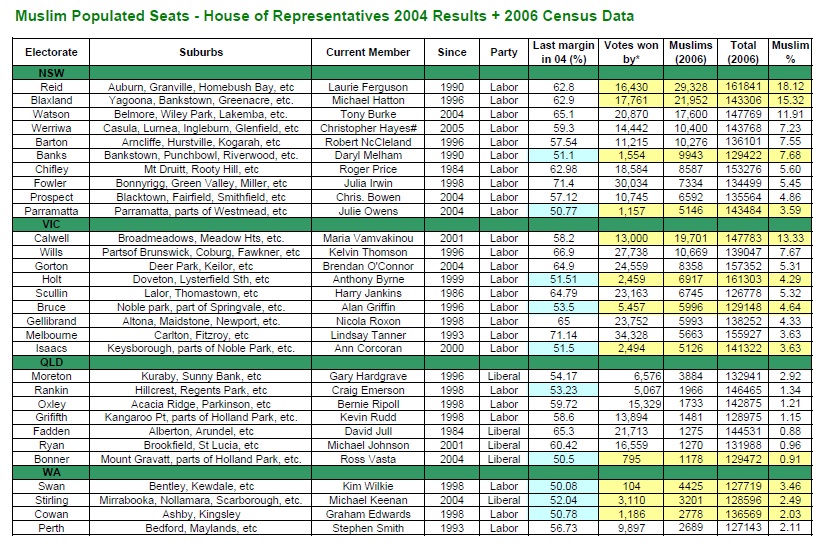
2 – Vote to make your seat as marginal as possible. This is particularly important for Australian Muslim voters who generally treated with political contempt because they live in seats that have the highest margins.
Imagine for example if the 16% of Australian Muslim voters of the western Sydney seat of Blaxland (centered around the Bankstown area) were to vote for anyone but the sitting Labor member. Because the seat is held by the same 16% margin, this would make the seat marginal. It is a open secret that marginal seats get the most attention/funding. 
Now imagine if this was repeated in another 3-4 seats  – like Reid, Barton, Watson and Calwell, where Australian Muslims make up at least 10% of the population. When we have serious prospects of a hung a Parliament  in today’s election and the fact that elections are generally only decided by a handful of seats, this becomes very significant.  Australian Muslim voters if they every became organised enough to block vote could play a major role in determining who gets elected to government. As the Australian Muslim population is relatively young (according to the 2006 census 60% under the age of 29 compared to 40% for the entire Australian population), this potential political strength will only increase over time.  
Here is analysis that was done for the 2004 election: 
Perhaps Australian Muslims becoming politically active can be a solution to the punching bag and dog whistle recipient political status they have endured for the last decade. And before I get the usual barrage of emails, Muslims have no intention of introducing Sharia law. They just want a dose of the famous Australian “fair go”. Nothing more, nothing less.  
On the election here is an interesting analysis that all political junkies I am sure will enjoy. It seems someone that has far more political insight and knowledge agrees with some of my thinking.

—————————————————————————————-

The Woman who could not wait

Peter Botsman 
In later life Julie Gillard will think back on 2010 with consternation. Whether she wins or loses the election tomorrow, she will wonder about whether it would have been better to wait for the opportunity to become Leader of the Labor Party and Prime Minister of Australia. Gillard was bred to be ruthless, in deposing Rudd she followed sage Labor advice. But later, and even now, having endured question after question about the fate of Kevin Rudd, her conscience will have been pricked but most of all she will wonder whether she was a pawn for others.
Whatever happens now Gillard will always be judged on the way she became leader of the Australian Labor Party.  If she loses Gillard will deeply regret her deposition of Kevin Rudd. If Kevin Rudd had won the election, he had clearly anointed her as his replacement. In the year 2011 or 2012, she would have made an easier ascendancy. If Tony Abbott had beaten Kevin Rudd, Gillard would have been made boss in 2011, would have been Leader of the Opposition against Abbott, and would have been seen as the hope of the progressive forces in the future.  If Rudd had won she could have looked forward to a more comfortable ascension. We know now that Gillard commanded overwhelming strength of numbers in the Labor caucus. After a second victory Rudd would have been tapped on the shoulder just in time for Prime Minister Gillard to develop a comfortable third term election strategy. Both of these paths would have been more honourable pathways to national leadership.
If Gillard wins tomorrow then she will also wonder about the wisdom of the coup against Rudd. She will wonder because she will only have just sneaked back into government with a margin that was not much better than Rudd’s worst poll numbers. Life will be much tougher and harder than it ever was for the Rudd government. There is every likelihood the greens will control the Senate. The Abbott opposition will be galvanised by their strong electoral performance and believe that it is only a matter of time before they win government. Abbott’s performance in bringing a first term government to the edge of oblivion will be applauded and Joe Hockey and Malcolm Turnbull will be kept at bay. The coalition will be cohesive and their mode of attack on the Gillard government will simply be to continue on with their current arguments against the sloppiness of Labor ? a government out of touch, feeding on debt and hostage to the Greens.
As the erstwhile Latham has already obersved there will also be, lined up at the new Prime Ministers door, a series of contenders, many of whom would have previously begged Gillard to stick the knife into Rudd, looking to get her job.
So what was it in the Gillard psychology and in the constitution of the contemporary Australian Labor Party that caused the move against Rudd?
There is nothing wrong with a clean, clear move against a leader. The problem is these days in the modern Labor party nothing is clean or clear. Whereas once there were people of character assessing the mood of the nation, today there are opinion polls and focus groups and party professionals. Such people who work at the nerve centre of the major political parties, do not know how to talk to human beings, they simply read trends in numbers. The Federal Labor Party secretariat envisioned by its great founder Cyril Wyndham was supposed to be outside of politics. Today it is a haven for such creatures and a tool of ambitious factional hacks all vying for a break over their rivals.
The entrance of women into Labor party positions and the parliament has done nothing to alleviate the corruption of Labor’s organs. It has perpetuated and heightened it. Labor’s affirmative action policy was first introduced into party thinking in 1981 and was given increasing substance in the form of quotas whereby it was expected that 40 per cent of party positions would be occupied by women by 2012. It was an extremely strong policy that is a tribute to many Labor women activists in the 1970s and 1980s. But its fatal flaw was that its implementation depended upon the existing party powerbrokers being behind it. The affirmative action policy changed the gender of party officials, party representatives to Labor party conferences and party parliamentary representatives but it did not change the nature or make up of the Australian Labor Party. In fact it arguably gave stronger influence to powerful, stale patriarchs than would have been the case if they had been challenged by women and men who represented new thinking about Labor and the nature of the party as was the case in the Labor party of the UK and the Democratic Party in the USA. Every nation’s progressive institutions have their quirks and weaknesses. The greatest problem of the Australian Labor Party, like the Australian constitution, is it is an extremely conservative institution that tends to entrench powerful interests regardless of their legitimacy.
Over the 1990s and 2000s men who were ?well beyond their used by dates’ used women to hold on to their positions within the Labor Party. Power-brokers and factional leaders scrambled to recruit loyal women from their own ranks to meet the party quotas of 20, 35 and 40 per cent women representatives and officials. Many older Labor leaders who were, and are now, accustomed to having breakfast, lunch and tea prepared by loyal wives, their children reared by loyal wives and their emotions calmed by loyal wives who kept the home fires burning (while they attended to more important matters) gave their benediction and influence to a flotilla of women who owed their power and influence to them. The new recruits tended to be extremely uncritical about the nature of the Labor machined. In fact grandmothers, sisters, aunties, mothers, wives and daughters were recruited on mass to head the symbolic political march to a more equitably gendered party. The most important thing was that the integrity of the factional influence was protected, and this was particularly important across all States and within the Federal machine for the Catholic right but also for the left factions. Having fought against the affirmative action policy for many years, the party’s bosses were well placed to use it to retain their own influence and power.
There were also a great number of extremely talented Labor women who emerged in this period and Julia Gillard was one of them. But ironically this alliance between the new Labor women and the older factional leaders took place at the same time as a major structural shift away from the structure of Labor in our economy and society. The affirmative action policy and the ability of the party bosses to use it meant that there was no deep understanding of the real issues facing Australian families moving away from traditional labor structures as well as patriarchal power structures. It also stymied any possibility of a more grass roots, democratic Labor party emerging. The new women union representatives, officials and representatives owed their existence to the old structure of Labor power not to any new form or possibility. Affirmative action meant that the structures of power and influence within the party did not change.
The women who excelled were part of a generation who did not have the organic links to new dynamic forces shaping our economy and society. Party professionals and leaders no longer work in unions to really represent their members. They do not do an apprenticeship in working life. A short term position in a union is just a step to political power. Instead of spending years alongside working people, aspirants go to university and learn how to spin jingles about ?working families moving forward?. They do law degrees but spend very little time, as little time as possible, in the magistrates courts dealing with grubby criminals and learning about the very real and fundamental questions of life and death in neighbourhoods. They dream about the constitution and abstract symbolic matters of state.
Later they become television heroes on morning talk shows but don’t know how to speak to their neighbours or their partners and families, let alone communities. It was this bubble of self interest that created a more fickle, non-organic approach to government policy, political leadership as well as the politically immature move against Kevin Rudd.
Those who advocate for a strong internal women’s policy within the Australian Labor Party may well ultimately be vindicated. I am sure that the women pioneers within the Labor Party would still argue that, whatever the costs, the current revolution is worthwhile. They will argue that from within the ranks of the female party hacks, good women will emerge quicker than would have been the case without the affirmative action policy. I hope they are right.
However all this does not change the scenario for Julia Gillard. She must live with the fact that she was a pawn for the ambitions of the Labor party’s factional bosses when she deposed Kevin Rudd. She must live with the fact that the deposition of Kevin Rudd was far from a clean, clear contest. It certainly was not even within the ethical mindset of the last generation of labour hacks. Even someone like Graham Richardson will have been surprised by its audacity. It belongs, as we have stated before, in the mindset of political commentators like Janet Albrechtson, Andrew Bolt and The Australianwho admire the sheer efficiency of a political machine turning over a poll unfriendly leader ruthlessly.
For ordinary people all this plays out differently. They may even vote for the ulimate political warrior of the right, Tony Abbott, because they perceive him to be a softer soul. After all they live in a world of increasingly ruthless bosses at work, bureaucrats and politicians many of whom are female. Many of whom are called upon to take the tough and nasty decisions which their male counterparts will not take.
Until the week before the challenge, Gillard had pledged her loyalty to Rudd as Prime Minister. Party professionals will have told her that this profession of loyalty did not matter. ?It was all for show. Everyone knows the game’ she will also have told herself. ?I am the best hope to beat Tony Abbott. I have his number? she will have told herself.  But, of course, on the streets, in the workplaces, in the neighbourhoods and in real life, it does matter that when someone professes loyalty that they mean it.   Just as the knowledge of those that work in hot ceilings installing insulation amongst dangerous electrical wires is fundamental to the success of a nationwide bureaucratic endeavour to insulate the nation’s houses.
Just as the experiences of those who have worked in remote communities experimenting with different housing models for Aboriginal families and failed and learned and failed and learned and failed and learned is more important than simply making a budgetary allocation to wish all these practical realities away. Just as the hardnosed views of parents who jealously guard the resources of their children in schools is far more important than the ideas of a new generation of well meaning bureaucrats who have never taught in schools, who have never been administrators in schools and have never even tapped the knowledge of those who have designed safe buildings and playgrounds for children.
We live in a world where symbolism often triumphs over substance. The public know, and women know too, that gender is sometimes a guise for the ruthlessness and hollowness that follows from this empty world. When there are unpopular and unpalatable things to be done and deeply devisive decisions to be taken it is interesting that women now often rise to the fore for better and for worse. Women in working life, in public institutions and in industry are often able to take actions and decisions that take the breath away from the toughest of their male counterparts. These are the things that the advocates of a new feminism for the 21st century must now contend with.
These are the things that Julia Gillard, whether she is Prime Minister or a humble Labor backbencher, will have to think about as she moves forward with her new life and career. Let us hope that she reflects well upon these matters and provides the kind of leadership that is so needed across our country today. Let us hope that Labor women move out and away from the shadows of the stale Labor factions and start to create a new kind of party that is not just a political advertising company but an organic part of our community. Let us hope..
But do not hold your breath. There are many interesting independent representatives and minor parties that deserve consideration tomorrow. Though it may well be premature to trust them with government, with the major parties so moribund, in the long term the well being and future of our country may depend upon investing in a new wave of candidates and parties. Australian citizens need more political choice and the major parties need more competition. If a Federal candidate or party gets more than 4 per cent of the formal first preference votes they receive electoral assistance of over $2 per vote in support from taxpayers. So supporting a candidate or or party get above this quote is a good thing. 
By supporting minor parties and independent candidates get over the 4 per cent quota revives our political system and gives us a new injection of candidates and ideas than those which the major parties currently dish up to us. So put this in your mind as you place a tick or a cross for your first preference in the house of representatives and senate on your ballot paper!!